
Table of Contents
ToggleMost indoor plants don’t need much, just decent light, water when the soil’s dry, and occasional feeding. But that last part trips up a lot of folks. You can’t just toss some granular fertilizer on top of a pothos and call it good. Indoor plants live in a closed system with finite nutrients in a small volume of soil, and liquid fertilizer is the most practical, forgiving way to replenish what they use up. It’s easy to mix, easy to apply, and your plants can take it up immediately through their roots. Whether you’re keeping a fiddle leaf fig alive or coaxing blooms out of a peace lily, understanding how to use liquid plant food for indoor plants makes the difference between surviving and thriving.
Key Takeaways
- Liquid fertilizer for indoor plants is superior to granular options because nutrients dissolve completely and are available to roots immediately, with better control over concentration and less risk of salt buildup.
- NPK ratios matter: nitrogen drives leafy growth, phosphorus supports blooms and roots, and potassium strengthens overall health—match the formula to your plant type (foliage vs. flowering vs. succulents).
- Always water your plant first with plain water, then apply diluted liquid fertilizer at the correct concentration to avoid root burn and nutrient waste.
- Adjust feeding frequency by season—feed every two weeks during spring and summer growth, but cut back to monthly or stop entirely in fall and winter when plants are semi-dormant.
- Common mistakes like over-fertilizing, feeding during dormancy, and skipping periodic soil flushes can lead to salt accumulation and root damage, so monitor your plants’ response and adjust accordingly.
- Match NPK formulas to plant needs: use balanced 3-1-2 for foliage plants, elevated phosphorus (7-9-5) for flowering plants, and diluted low-nitrogen (2-7-7) formulas for succulents and cacti.
Why Liquid Fertilizer Is the Best Choice for Indoor Plants
Liquid fertilizer dissolves completely in water, which means nutrients are available to plant roots almost immediately. That’s a big deal indoors, where you’re not dealing with rain, microbial activity, or earthworms breaking down slow-release granules.
Granular or spike fertilizers can work, but they’re harder to control. You might get uneven distribution, nutrient pockets that burn roots, or slow breakdown that doesn’t match your plant’s growth cycle. Liquid formulas let you adjust concentration on the fly, dilute more for seedlings, less for established plants, or skip a feeding if growth slows in winter.
Another advantage: liquid fertilizers are less likely to build up salts in the potting mix. Salt accumulation (that white crust on the soil surface) happens when you over-fertilize or under-water, and it can damage roots. With liquid feeding, you’re flushing the soil each time you water, which helps prevent buildup if you’re using the right dilution.
You’ll also find liquid options in organic and synthetic formulas. Organic liquid fertilizers, like fish emulsion, seaweed extract, or compost tea, release nutrients more gradually and improve soil biology. Synthetic blends deliver precise NPK ratios and micronutrients, which is useful if you’re targeting specific deficiencies or growth stages.
Understanding NPK Ratios and What Your Indoor Plants Need
Every fertilizer label shows three numbers, NPK ratio, representing nitrogen (N), phosphorus (P), and potassium (K) by weight. A 10-10-10 formula has equal parts of each. A 5-1-1 is nitrogen-heavy. Knowing what each does helps you match fertilizer to plant type.
Nitrogen (N) drives leafy growth. It’s the nutrient foliage plants (pothos, philodendron, snake plants) crave most. If your plant’s new leaves are pale or growth is sluggish, it’s often nitrogen-deficient.
Phosphorus (P) supports root development and flowering. Blooming plants, African violets, orchids, begonias, benefit from formulas with a higher middle number, like 7-9-5. Phosphorus also helps seedlings establish strong roots early on.
Potassium (K) strengthens overall plant health, disease resistance, and water regulation. It’s less visible than nitrogen or phosphorus but critical for stress tolerance, especially in dry indoor environments.
Most general-purpose indoor plant fertilizers sit around 3-1-2 or 10-10-10. That’s fine for a mixed collection. But if you’re serious about a specific plant group, tweaking the ratio pays off. For example, cacti and succulents do better with low-nitrogen formulas like 2-7-7, which discourage leggy growth and promote compact form.
Some liquid fertilizers also include micronutrients, iron, magnesium, calcium, manganese. These aren’t always listed in the NPK but are essential for chlorophyll production and enzyme function. If you see yellowing between leaf veins (interveinal chlorosis), that’s often an iron or magnesium deficiency, and a comprehensive home improvement approach to plant care includes micronutrient awareness.
How to Choose the Right Liquid Fertilizer for Different Plant Types
Not all indoor plants want the same diet. Matching fertilizer to plant type keeps things simple and effective.
Flowering and Fruiting Plants
If you’re growing anything that blooms or sets fruit indoors, citrus trees, hibiscus, Christmas cactus, orchids, look for a fertilizer with elevated phosphorus. A 7-9-5 or 5-10-5 ratio encourages bud formation and longer-lasting flowers.
Orchids are picky. They prefer dilute feeding, quarter-strength weekly or half-strength biweekly, using a formula designed for epiphytes, often 20-20-20 or 30-10-10 depending on growth phase. Don’t use standard houseplant fertilizer at full strength: it’ll burn the roots.
For edibles like indoor herb gardens or dwarf peppers, choose a food-safe organic option. Fish emulsion and kelp blends work well here. Some growers prefer organic solutions like sea kelp for micronutrient density and gentle feeding.
Foliage Plants and Succulents
Foliage plants, monsteras, ferns, rubber plants, calatheas, thrive on balanced or nitrogen-rich formulas. A 3-1-2 or 10-5-5 keeps leaves dark green and growth steady. Apply every two to four weeks during the growing season (spring through early fall).
Succulents and cacti need much less. Use a 2-7-7 cactus fertilizer diluted to half strength, and feed only during active growth, usually late spring and summer. Over-feeding succulents leads to stretched, weak growth and root rot.
For low-light plants like ZZ plants or snake plants, cut feeding frequency in half. These slow growers don’t use nutrients quickly, and excess fertilizer just sits in the soil, raising salt levels.
Step-by-Step Guide: How to Apply Liquid Fertilizer Correctly
Applying liquid fertilizer isn’t complicated, but there’s a right sequence to avoid root burn and waste.
1. Water the plant first. Never apply fertilizer to dry soil. Dry roots can’t absorb nutrients efficiently, and concentrated fertilizer can scorch them. Water until it drains from the bottom, wait 10–15 minutes, then fertilize.
2. Mix the fertilizer at the correct dilution. Follow label instructions. Most liquid fertilizers call for 1 teaspoon per gallon or 1 tablespoon per gallon, but always double-check. If you’re using a concentrate, measure carefully, eyeballing leads to over-application.
For sensitive plants or seedlings, start at half the recommended strength. You can always increase later if growth is slow.
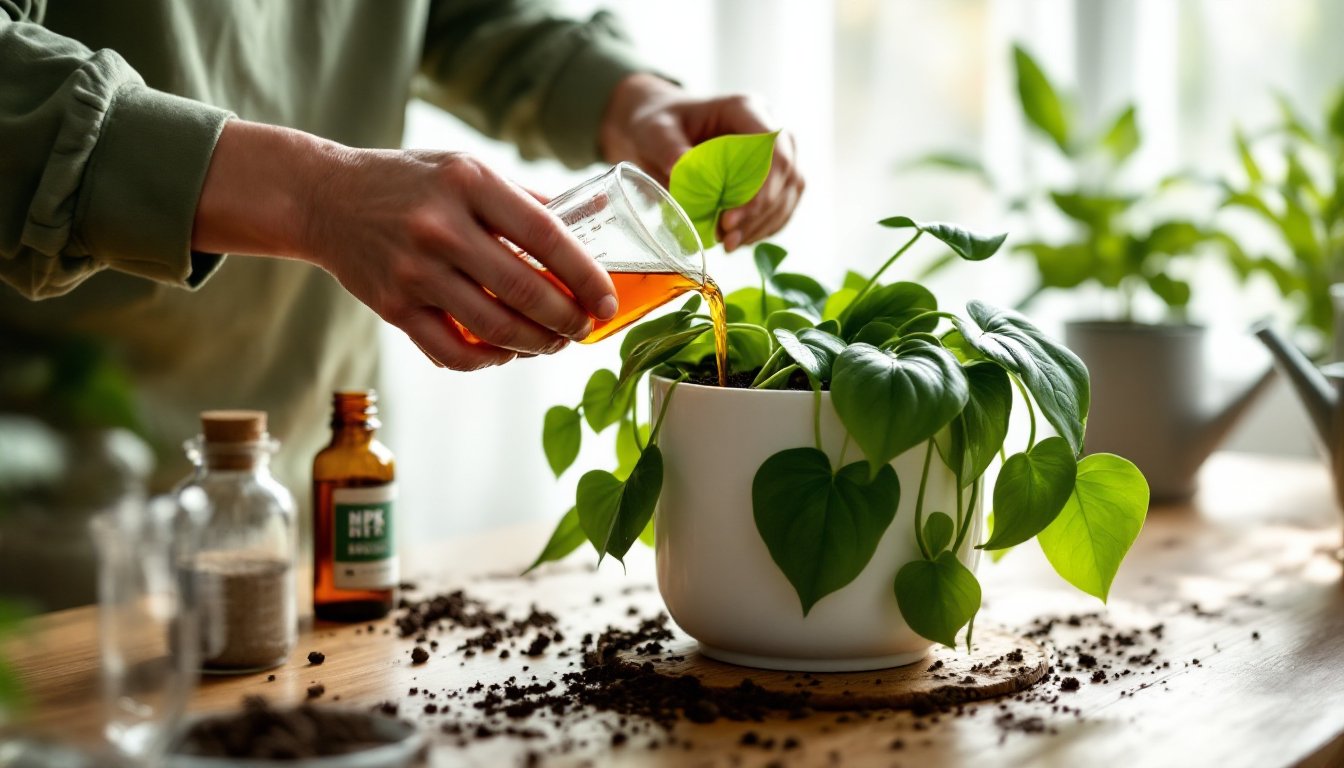
3. Apply the solution evenly. Pour the diluted fertilizer over the soil surface, avoiding leaves and stems. Aim for the same volume you’d use during a regular watering. You want the solution to reach the root zone, not just sit on top.
4. Let it drain. If your pot has drainage holes (and it should), let excess solution run out into a saucer. Dump the saucer after 15–20 minutes so the plant isn’t sitting in standing water.
5. Adjust frequency by season. Feed every two weeks during active growth (spring and summer). Cut back to monthly or stop entirely in fall and winter when most houseplants go semi-dormant. Low light and cool temperatures slow metabolism, so plants use fewer nutrients.
Safety note: Wear gloves if you’re handling concentrated fertilizer, especially synthetic blends. Some can irritate skin. If you’re using fish emulsion or other organic liquids, expect a strong smell, use it in a well-ventilated area or outdoors if possible.
Keep fertilizer in its original container, tightly sealed, and out of reach of kids and pets. Most liquid fertilizers are stable for a year or two, but check the expiration date.
Common Mistakes to Avoid When Using Liquid Fertilizer Indoors
Even experienced plant owners mess up fertilizing now and then. Here’s what to watch for.
Over-fertilizing. More is not better. Excess nutrients lead to salt buildup, leaf tip burn, wilting, and stunted growth. If you see brown, crispy leaf edges or a white crust on the soil, flush the pot with plain water, run water through the soil for a few minutes until it drains clear, then let it dry normally.
Feeding during dormancy. Most houseplants slow or stop growing in winter. Fertilizing a dormant plant wastes product and can stress roots. Wait until you see new growth in spring before resuming regular feeding.
Ignoring water quality. If your tap water is heavily chlorinated or softened with sodium, it can interfere with nutrient uptake or add unwanted salts. Let tap water sit overnight to off-gas chlorine, or use filtered or distilled water for mixing fertilizer.
Using the wrong NPK for the plant type. A cactus doesn’t need the same food as a fiddle leaf fig. Match the formula to the plant’s growth habit and life stage. When in doubt, a balanced 10-10-10 or 3-1-2 works for most general collections.
Skipping the flush. Even with proper dilution, salts accumulate over time. Every few months, flush each pot with plain water to rinse out buildup. This is especially important if you’re using synthetic fertilizers or hard water.
Applying fertilizer to sick plants. If a plant is struggling, yellowing, dropping leaves, root rot, fertilizer won’t fix it and may make things worse. Diagnose the real problem first: light, water, pests, or root health. Fertilizer feeds healthy, growing plants: it doesn’t revive dying ones.
Not adjusting for pot size. A plant in a 4-inch pot needs far less fertilizer than one in a 12-inch pot. If you’re using a pre-diluted spray or ready-to-use bottle, be mindful of volume. For larger pots, mixing your own concentrate gives better control.
Finally, don’t assume all decorating and care strategies apply universally, plant care is as individual as the species you’re growing. Pay attention to how your plants respond, and adjust feeding based on growth rate, leaf color, and overall vigor. That’s the real skill.