
Table of Contents
ToggleHome organization vs. decluttering, these terms get tossed around like they mean the same thing. They don’t. One focuses on creating systems. The other focuses on letting go of stuff. Understanding the difference between home organization and decluttering can save hours of frustration and help anyone create a space that actually works.
Many people dive straight into buying storage bins and labeled containers, only to realize they’ve organized a pile of things they don’t even need. Others purge everything in sight but end up with bare shelves and no real system to maintain order. The truth? Both approaches serve distinct purposes, and knowing when to use each one makes all the difference.
Key Takeaways
- Home organization creates systems and structure for your belongings, while decluttering focuses on reducing the number of items you own.
- Always start with decluttering before organizing—fewer items mean simpler, more sustainable systems.
- Organizing an overstuffed space leads to temporary fixes, but decluttering first creates lasting solutions.
- Combine both methods by decluttering room by room, then implementing organizational systems for what remains.
- Use the “one in, one out” rule and schedule quarterly maintenance to keep your home functional long-term.
What Is Home Organization?
Home organization is the process of arranging belongings in a logical, accessible way. It assigns every item a specific home. The goal is simple: make daily life easier by reducing the time spent searching for things.
Organization involves systems. Think drawer dividers, shelf risers, labeled bins, and closet configurations. A well-organized kitchen stores pots near the stove and dishes near the dishwasher. A functional entryway has hooks for keys and a designated spot for mail.
The key characteristic of home organization is structure. It doesn’t necessarily reduce the number of items someone owns. Instead, it creates order among existing possessions. Someone could organize a closet packed with 200 items just as easily as one with 50, though the latter would certainly be faster.
Effective organization considers three things:
- Accessibility: Items used daily should be within easy reach
- Categorization: Similar items belong together
- Consistency: Everyone in the household knows where things go
Home organization works best when spaces contain a reasonable number of items. Attempting to organize an overstuffed room often leads to temporary fixes rather than lasting solutions.
What Is Decluttering?
Decluttering is the act of removing unnecessary items from a space. It’s about subtraction, not arrangement. The process forces decisions: keep, donate, sell, or trash.
Unlike home organization, decluttering doesn’t require any special products or systems. It requires honesty. Someone must evaluate each item and decide whether it serves a purpose or brings value to their life.
Decluttering addresses the root cause of disorganized spaces, too much stuff. According to the National Association of Productivity and Organizing Professionals, the average American home contains around 300,000 items. That’s an overwhelming number to manage, no matter how many storage solutions someone buys.
The decluttering process typically involves:
- Sorting: Grouping items by category or room
- Evaluating: Deciding what stays and what goes
- Removing: Getting unwanted items out of the house immediately
Many people find decluttering emotionally challenging. Letting go of gifts, inherited items, or things tied to memories can feel difficult. But holding onto items out of guilt or obligation creates physical and mental weight.
Decluttering creates breathing room. It reduces visual noise and makes subsequent organization far more manageable.
Core Differences Between Organization and Decluttering
The distinction between home organization vs. decluttering comes down to purpose and process.
| Aspect | Home Organization | Decluttering |
|---|---|---|
| Primary Goal | Create systems and structure | Reduce the number of possessions |
| Focus | Arrangement and accessibility | Elimination and simplification |
| Tools Needed | Bins, dividers, labels, shelving | Trash bags, donation boxes |
| Emotional Demand | Low to moderate | Often high |
| Time Investment | Varies by space | Can be intensive upfront |
Organization answers the question: “Where should this go?” Decluttering answers: “Should I keep this at all?”
Here’s an analogy that might help. Imagine a closet overflowing with clothes. Organizing that closet means adding more hangers, installing a second rod, and folding sweaters into neat stacks. Decluttering means pulling out the shirts that haven’t been worn in two years and donating them.
Both actions improve the closet. But only decluttering reduces the volume of what needs managing. And only organization creates a sustainable system for what remains.
Another key difference involves sustainability. Organized spaces can slide back into chaos quickly if they contain too much stuff. Decluttered spaces stay manageable longer because there’s simply less to deal with.
Home organization vs. decluttering isn’t an either/or debate. They work together. But understanding which one a space needs first prevents wasted effort.
Which Approach Should You Start With?
Start with decluttering. Almost always.
Organizing before decluttering is like rearranging deck chairs on the Titanic. It creates an illusion of progress without addressing the underlying problem. When too many items exist in a space, no organizational system can keep up.
Professional organizers consistently recommend the same sequence: declutter first, organize second. This approach offers several advantages:
- Less to organize: Fewer items mean simpler systems
- Clearer vision: Empty spaces reveal what’s actually needed
- Cost savings: No buying storage products for items that shouldn’t stay
That said, some situations call for organization first. If someone moves into a new home, they might need to organize quickly just to function. In that case, a preliminary organization makes sense, with decluttering planned for later.
Another exception involves extremely cluttered spaces where someone can’t even see what they own. A rough sort into categories can help before the actual decluttering begins.
But for most people tackling home organization vs. decluttering decisions, the rule holds: reduce first, then arrange what’s left.
Combining Both Methods for Lasting Results
The most effective approach treats decluttering and home organization as two phases of one project.
Phase one involves decluttering room by room or category by category. The KonMari method suggests sorting by category (clothes, books, papers, miscellaneous, sentimental items). Other experts recommend tackling one room at a time. Either way, the goal is removing what doesn’t belong before moving on.
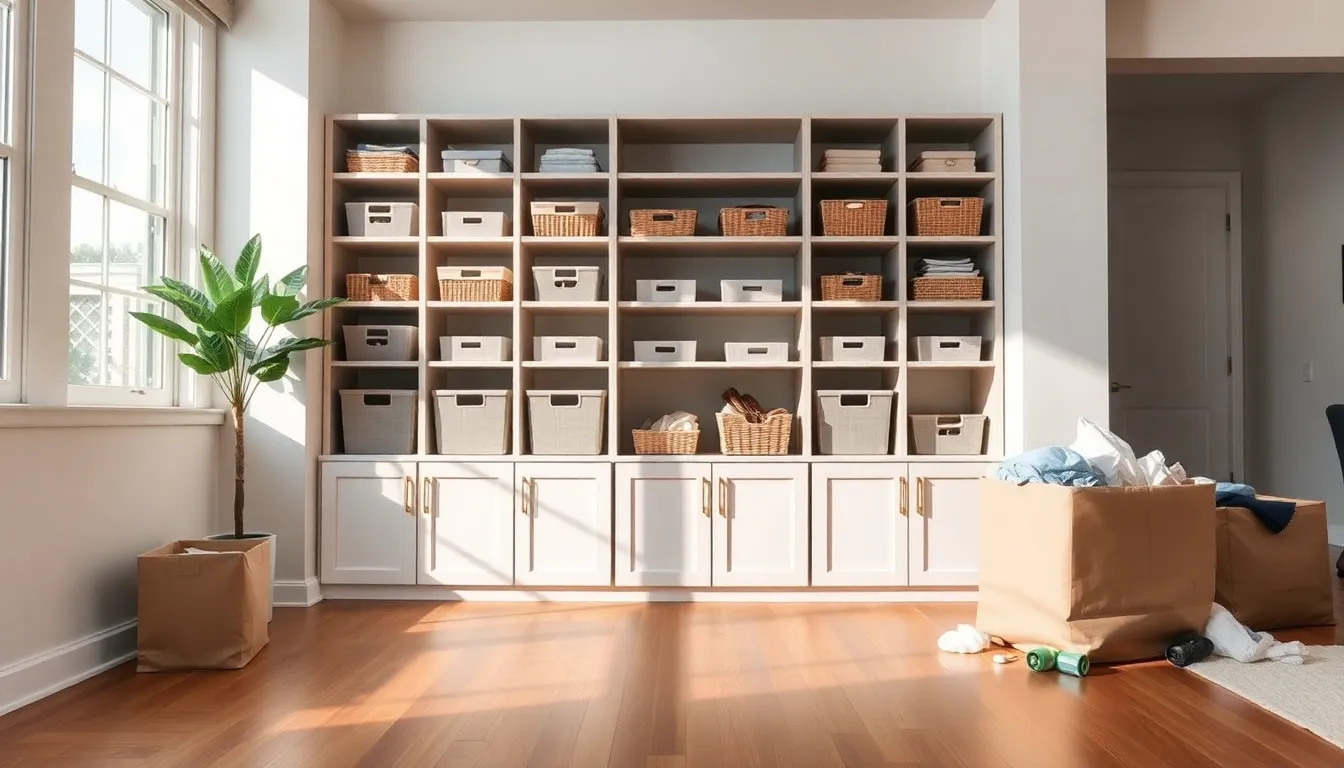
Phase two brings in organization. Once a space contains only items someone wants to keep, systems make sense. This is when labels, bins, and storage solutions earn their place.
Maintenance becomes the third piece. Neither decluttering nor home organization is a one-time event. Stuff accumulates. Systems break down. Scheduling regular check-ins, quarterly or seasonally, keeps spaces functional.
Some practical tips for combining both methods:
- Use the “one in, one out” rule: When something new enters the home, something old leaves
- Set time limits: Spending 15 minutes daily on maintenance prevents major projects later
- Reassess annually: What worked last year might not work now
The combination of decluttering and home organization creates spaces that function well and stay that way. One without the other rarely produces lasting results.